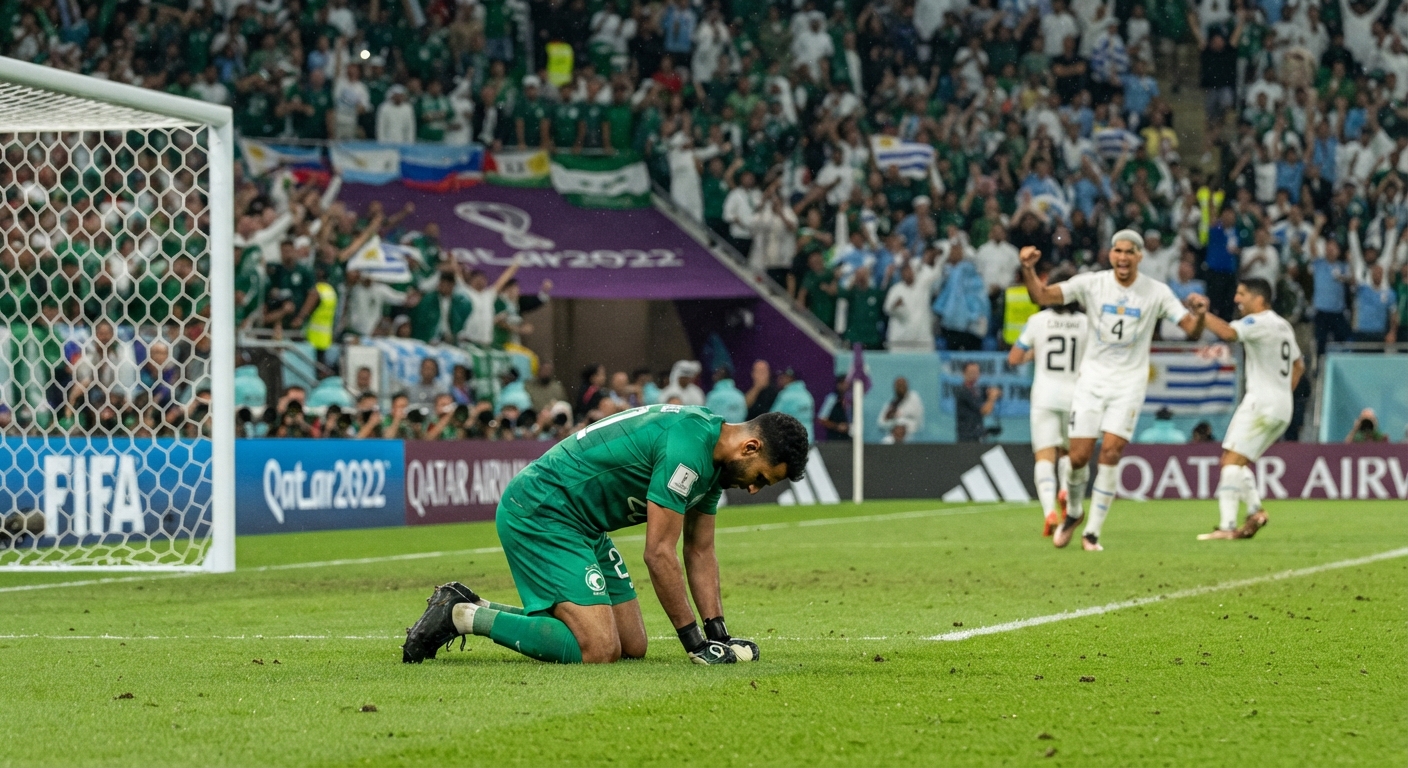
Mohammed Al-Owais spent ninety minutes turning Uruguay's front line inside out, and it still was not quite enough. Maxi Araujo's clinical finish in the dying seconds pulled Uruguay level at 1-1 in a group-stage meeting that will be remembered less for the scoreline than for the goalkeeper who very nearly made off with all three points. Fahad Al-Ghashayan's 24th-minute strike had Saudi Arabia dreaming of a statement win over one of South America's traditional heavyweights, and for long stretches Al-Owais made that dream look entirely believable.
Al-Owais's Heroics and Araujo's Late Equaliser
Uruguay arrived at the tournament with the pedigree of two World Cups and a squad still anchored by Luis Suárez and Edinson Cavani, and for most of the first hour they played like the superior side without ever finding the finish to match. Al-Ghashayan's opener, arriving against the run of general possession, forced Uruguay into exactly the kind of chase that flatters a well-drilled defence, and Saudi Arabia sat in with real discipline behind it. Al-Owais was the man who made that shape hold. He got a strong hand to a Suárez effort that looked destined for the top corner, then somehow adjusted his body to smother a close-range header from Cavani that had beaten him for placement if not for reflexes.
Uruguay kept coming, kept probing, and kept being told no. It took until stoppage time for the breakthrough, Araujo ghosting into space and finishing with the composure of a player who refused to let the night end in defeat. It was a deserved goal on the balance of the chances created, even if the numbers suggested Uruguay's toothlessness in front of goal was as much the story as Al-Owais's brilliance.
Twelve shots on target, one goal until the ninetieth minute — that is the story of a goalkeeper refusing to blink.
- Final score: Saudi Arabia 1-1 Uruguay
- Scorers: Fahad Al-Ghashayan (24'), Maxi Araujo (90+)
- Shots on target: Uruguay 12, Saudi Arabia 5
- Possession: Uruguay 62%, Saudi Arabia 38%
- Standout performer: Mohammed Al-Owais, multiple key saves vs Suárez and Cavani
- Result impact: Point keeps Saudi Arabia's group campaign alive despite squandered lead
A Point That Preserves Saudi Ambition
For Saudi Arabia, the result did nothing to dent the credibility they have been building on the biggest stage. Getting a point off Uruguay after leading for the best part of seventy minutes is the sort of result that keeps a group-stage campaign alive, and Al-Owais's performance will have been watched closely by managers scouting for the knockout rounds, where his side will hope to be by the time the tournament reaches this Round of 16 stage. The Green Falcons have made a habit in recent tournaments of frustrating sides with better reputations, and this was another data point in that pattern. They defended in numbers, broke with purpose through Al-Ghashayan, and asked serious questions of a Uruguay side many had expected to cruise.
"You cannot coach what Mohammed did tonight. Some nights a goalkeeper decides the game belongs to him, and Suárez and Cavani found that out the hard way." — Hervé Renard, Saudi Arabia coach
The Tactical Battle: Uruguay's Struggles and Saudi Arabia's Approach
Tactically, this was a lesson in the gap between territory and end product. Uruguay dominated the ball and camped in Saudi Arabia's half for long periods, yet their build-up too often broke down in the final third. Suárez and Cavani, still capable of moments of real quality, were starved of the service that suits them, forced instead to drop deep and manufacture their own chances against a back line that refused to be dragged out of position. Without a genuine focal point pinning the Saudi centre-backs, Uruguay's wide players kept delivering crosses into congestion rather than space, and the visitors' back four, marshalled superbly in front of Al-Owais, dealt with almost everything that came their way. It is the kind of profligacy that looks manageable against a well-organised Saudi Arabia but becomes far more costly against the elite sides now waiting in the Round of 16.
Saudi Arabia's approach, by contrast, was a model of pragmatism. They sat compact, denied central passing lanes, and trusted their goalkeeper to deal with whatever slipped through. Al-Ghashayan's goal came from precisely the kind of transition their setup was designed to produce — patient defending followed by a quick, direct outlet. That they were unable to see the lead out says more about the concentration required to hold off a team of Uruguay's quality for ninety minutes than it does about any tactical failing.
What It Means Going Forward
Conceding in the final seconds after dominating the psychological battle for so long will sting, but Saudi Arabia leave this match with more credit than damage. A point against a South American giant, built on a goalkeeper performing at the very top of his powers, is exactly the kind of result that fuels belief in a squad still fighting for its place among the tournament's bigger names. For Uruguay, the warning signs are harder to ignore. A front line built around Suárez and Cavani cannot keep relying on stoppage-time drama to paper over a finishing problem that eventually, against sharper opposition, will cost them the points that matter most.
As the tournament moves deeper into its knockout phase, both sides will take different lessons from this draw — one a reminder that discipline and a world-class goalkeeper can neutralise superior talent for long stretches, the other a nagging sense that dominance without conversion is a currency that runs out fast when the stakes are highest.