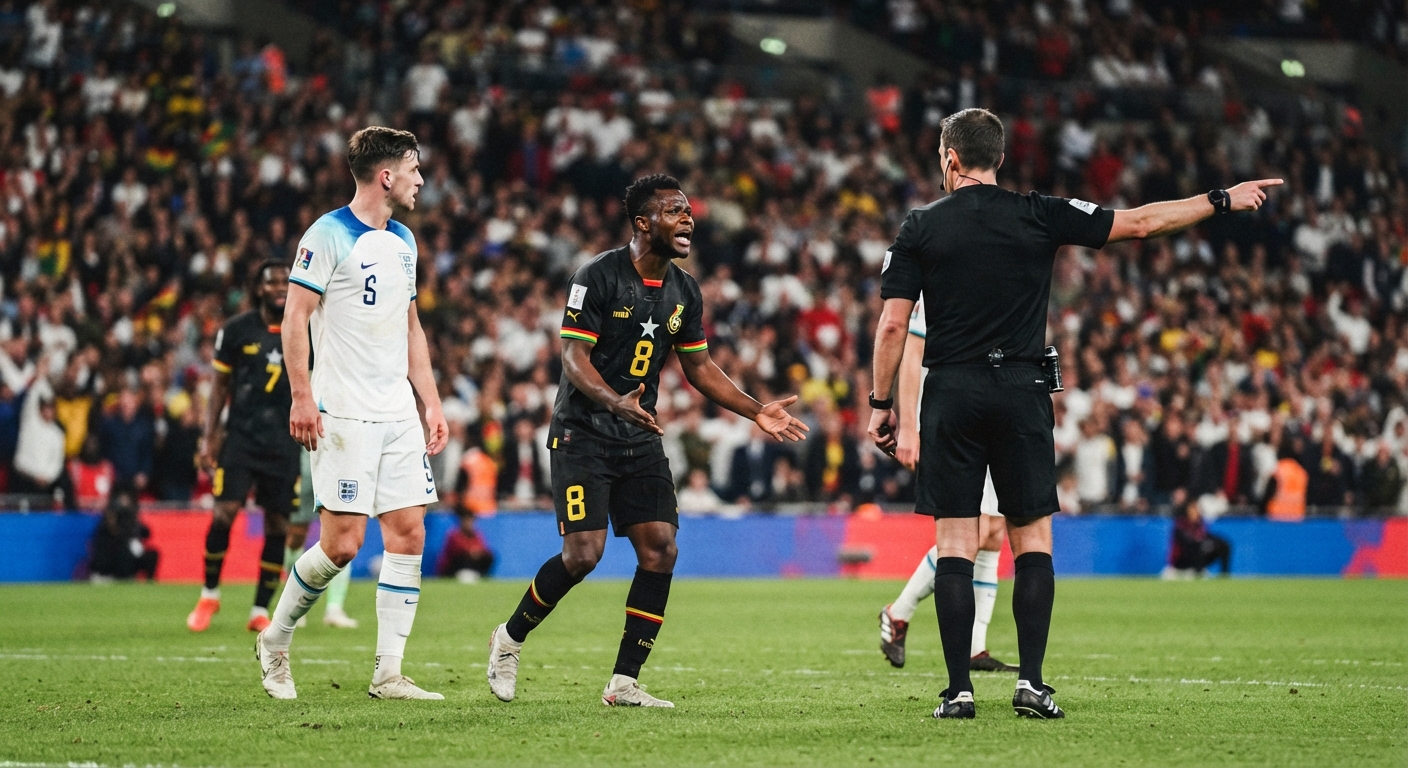
England are in the Round of 16, Ghana are on a flight home, and one moment from their group-stage draw still won't leave the conversation. Deep into a goalless stalemate last month, substitute Prince Adu burst into the England box and went down under a challenge from Ezri Konsa. No penalty was given, no VAR review followed, and the game petered out at 0-0. Weeks later, with Thomas Tuchel still navigating his first tournament in charge of England, pundits and Ghanaian players alike are still asking why nobody blew a whistle.
The Challenge That Split Opinion
Adu had run through the inside-left channel and dragged the ball beyond Konsa, who launched himself into the challenge a fraction of a second late. Replays showed the defender's boot catching Adu's knee well before either man touched the ball — the kind of contact referees in the Premier League have punished repeatedly this season. The official, with a clear line of sight, waved for play to continue.
Wayne Rooney, working the match for the BBC, didn't hold back afterwards, arguing Konsa had "gone to ground and got the man, not the ball." Micah Richards agreed, insisting defenders need to know the line will be drawn tightly "even when it's the last ten minutes and a point is on the line." Not everyone saw it that way — some observers argued the contact was marginal enough for referees at this level to let it run. That split is exactly why the incident has had such a long shelf life.
A stonewall penalty, according to a former Premier League official — and it was never even sent upstairs.
Collina's Instructions and the VAR That Never Came
Pierluigi Collina, chairing FIFA's referees committee for this World Cup, has been explicit that officials should let contact go unless it's unambiguous — wary of a tournament remembered for stoppages rather than football. That guidance explains plenty about why the referee played on. It explains far less about why the video assistant referee, watching the same replay angles that had Rooney convinced within seconds, never called for a pitch-side review.
"For me, this was a penalty kick. The VAR's job in that moment is to check for a clear and obvious error, and I think this qualifies." — Darren Cann, former Premier League assistant referee
Ghana's staff made an informal approach to match officials after the game seeking clarification; FIFA has not commented publicly on the incident since. The inconsistency matters because it isn't isolated. Fans have spent this tournament comparing penalty decisions across matches with wildly different degrees of contact, and a non-call that a former official labels a stonewall penalty sits awkwardly next to spot-kicks awarded elsewhere for far less.
- Fixture: England 0-0 Ghana, group stage
- Incident: Ezri Konsa challenge on substitute Prince Adu, no penalty given
- VAR outcome: No pitch-side review requested
- England's group form: Beat Croatia 4-2, drew Ghana 0-0, through to Round of 16
- Ghana's tournament: Eliminated at the group stage
- Manager under scrutiny (indirectly): Thomas Tuchel, in his first tournament as England boss
Ghana Left with Nothing, England Left Relieved
For Ghana, the point from that draw wasn't enough to save their tournament; they head home with the Adu incident as their defining memory of the World Cup. Players spoke about it in the mixed zone with visible frustration, several suggesting that had the roles been reversed — England appealing rather than absorbing — the outcome would have been different. That perception, fair or not, has followed African teams through recent tournaments, and Ghana's exit will feed a familiar argument about whose penalty shouts get taken seriously on the biggest stage.
England, by contrast, moved on almost immediately. The draw with Ghana came sandwiched between a 4-2 win over Croatia and the knockout rounds, and Tuchel's side have barely looked back since. There was no post-match apology, no acknowledgement from the England camp that the decision had been close. For a team trying to build knockout momentum under a new manager, a lucky break in a dead-rubber-feeling draw is the kind of thing you file away and forget.
One team's forgettable footnote is another's entire tournament story.
A Pattern Bigger Than One Game
What keeps the story alive isn't just the missed call itself, but the company it now keeps. Brazil's extra-time win over Cape Verde and their penalty shootout victory over Netherlands have both drawn their own officiating debates in the days since, suggesting Collina's committee has a consistency problem that extends well beyond one afternoon at Wembley. Every marginal call from here through the final at MetLife on 19 July will now be measured against the Adu-Konsa incident, whether officials like it or not.
Ghana cannot appeal their way back into the tournament, and nothing FIFA says now changes their group-stage exit. But the debate has become a useful stick with which to beat a refereeing system that promised more clarity than it has delivered. Tuchel's England will want the conversation to move on to Round of 16 opponents and tactics. Ghana's players, still processing an early flight home, are entitled to make sure it doesn't disappear quite that easily.