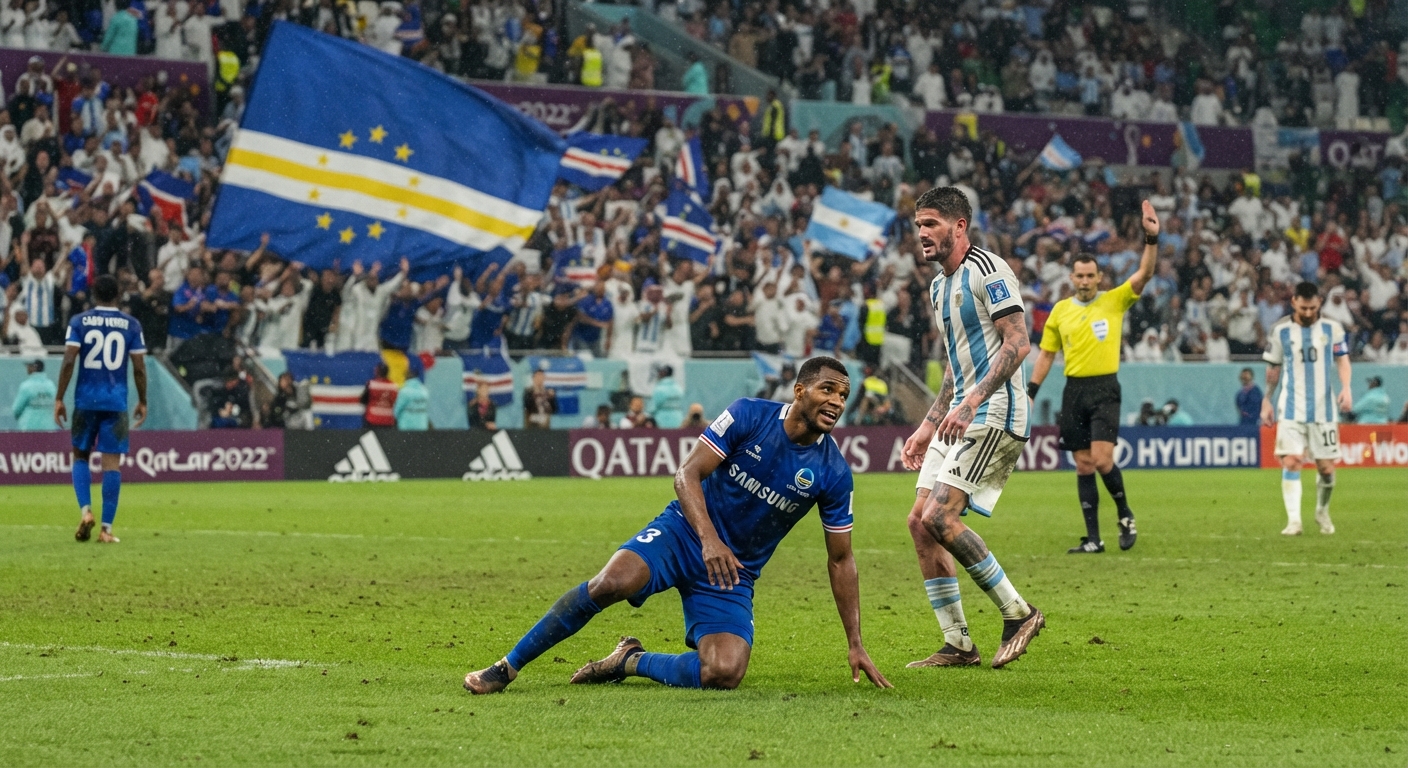
Cape Verde's World Cup finally ran out of road on Sunday night, when Argentina needed extra time to see off the smallest nation ever to reach the knockout stages. The Blue Sharks, representing an archipelago of 525,000 people scattered across ten islands in the Atlantic, fell 2-1 after 120 minutes, but the manner of the exit told its own story. They led. They pushed the world champions to the brink. And when it was over, players from both sides embraced for minutes on the touchline, Argentina's substitutes applauding a team that had no business making this tournament feel so difficult.
A nation with fewer people than Leicester just made the world champions play extra time to get past them.
How They Got Here
The group stage alone would have justified the celebrations back home. Drawn alongside Brazil, Switzerland and Iran, Cape Verde opened with a goalless half against Brazil that turned into a 1-1 draw, Ryan Mendes converting a second-half penalty after Vozinha, the 40-year-old goalkeeper who has become the unlikely face of this campaign, had already denied Brazil twice in the first period. A 2-0 win over Iran followed, then a battling 0-1 loss to Switzerland that mattered little — Brazil's dominance elsewhere meant four points was enough to finish second in the group. Nobody outside Praia had given Cape Verde a chance of reaching the last 16. Vozinha's saves against Brazil are already being replayed on television back on Santiago island.
Roberto Lopes, the captain, had said before the Argentina match that the squad no longer viewed itself as a story of overachievement. "Since I've been involved, there's been an ongoing plan to get Cape Verde to the big table, and we're seeing the results of that work now," he said. It was not false modesty. This is a federation that has spent a decade building a pipeline into the Portuguese and Dutch academies where much of the Cape Verdean diaspora grew up, and it shows in a squad where 14 of the 26 players were born outside the islands.
A Performance, Not a Token Appearance
Against Argentina, Cape Verde did not sit back and hope. Dailon Livramento, the 22-year-old forward who scored the goal that sealed World Cup qualification against Cameroon, put them ahead in the 34th minute with a low finish after a mistake by Argentina's centre-back pairing, and for long stretches of the second half it looked as though the smallest nation in World Cup history might produce the upset of the tournament. Argentina equalised through a scrambled corner just past the hour, and the game tipped into extra time still level. A substitute's strike ten minutes from the end of the additional period finally separated the sides, but Cape Verde had chances to win it in normal time that better finishing might have taken.
- Population represented: 525,000 across ten Atlantic islands
- Group stage record: 1 win, 1 draw, 1 loss — four points, second in Group H
- Result vs Brazil: 1-1 draw, Ryan Mendes penalty
- Result vs Iran: 2-0 win
- Squad makeup: 14 of 26 players born outside Cape Verde
- Exit: Lost 2-1 to Argentina after extra time in the Round of 16
Lopes had talked all week about belief rather than fear. "There's confidence in this team that we are good enough to mix with the best," he said before kick-off, and nothing in the 120 minutes against Argentina suggested he was wrong. Vozinha made three more saves. Livramento was a constant threat off the left. Cape Verde's back line, built around Lopes and organised with a discipline that has been the hallmark of this run, gave up almost nothing that Argentina did not have to work hard for.
"We didn't come here to make up the numbers. We came here to compete, and I think tonight we showed the whole world what Cape Verde is capable of." — Roberto Lopes, Cape Verde captain
What the Run Leaves Behind
The scale of what Cape Verde achieved does not shrink because the run ended in a Round of 16 tie rather than further glory. This is a country with fewer people than Leicester, no top-flight domestic league to speak of, and a football federation that until recently operated on a fraction of the budget of its Group H opponents. Reaching the World Cup at all, in a field expanded to 48 teams for the first time, was remarkable. Winning a point off Brazil and pushing Argentina to extra time turns remarkable into something closer to historic.
The federation's president has already spoken about using the tournament's exposure to secure investment in facilities on the islands, where many young players still learn the game on sand and gravel pitches rather than grass. That, more than any single result, may prove to be the lasting legacy of this campaign — not just the memory of Vozinha's saves or Livramento's finish against Argentina, but the pathway it opens for the next generation of Cape Verdean footballers who will grow up believing the World Cup is somewhere they belong, not just somewhere they visit once.
A Squad That Refused to Be Overawed
What set this Cape Verde side apart from previous minnows at World Cups was not just the results but the temperament. There was no sense, at any stage against Brazil, Switzerland, Iran or Argentina, that the Blue Sharks were happy simply to be there. Lopes' pre-tournament insistence that the squad had stopped thinking of itself as a fairytale and started thinking of itself as a football team was borne out in every performance, and especially in the way they attacked a two-time world champion with intent rather than caution. Argentina's players, by their own admission in the mixed zone afterwards, had not expected a game of this difficulty from a nation ranked so far below them.
For a federation that a decade ago could barely fund a training camp, that is the real headline. The scoreline says Cape Verde lost. Everything else about the last month says something rather different — that the smallest nation in World Cup history left the tournament as one of its most respected teams, and that this is very unlikely to be the last anyone sees of them on this stage.