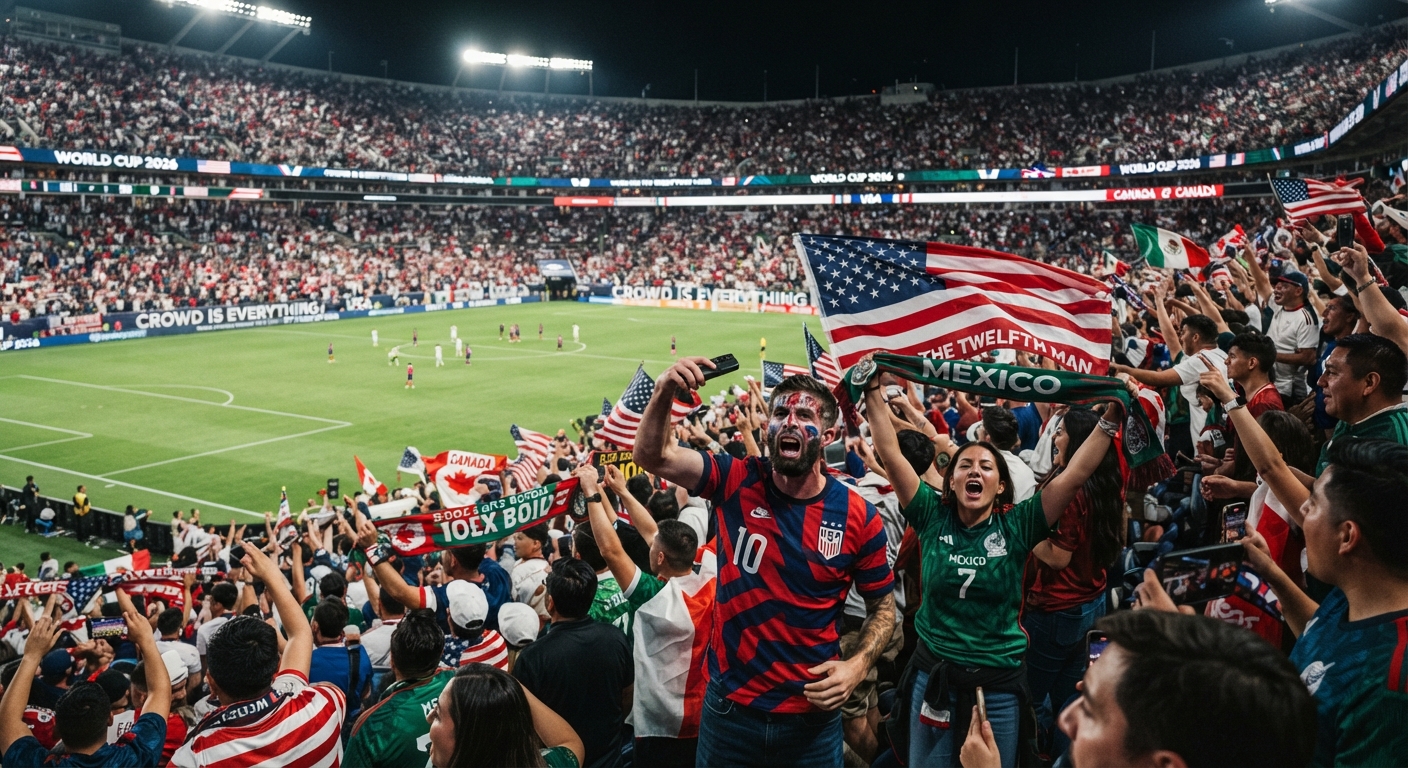
Long after the final whistle in Cape Verde's stunning 1-1 draw with Brazil, the sound inside the stadium refused to die down. A team ranked 67th in the world, representing an island nation of fewer than 600,000 people, had just taken a point off the five-time champions, and their supporters made sure everyone in the ground knew what it meant. Drums, horns and a chant that seemed to loop endlessly around the concourse followed the players down the tunnel. It was one of the first true statement moments of the group stage, and the tone has carried all the way to the Round of 16: this World Cup is being shaped as much by what happens in the stands as by what happens on the grass.
Some crowds don't just support a team. They become part of the scoreline.
A Tournament Built For Noise
Spreading 104 matches across the United States, Canada and Mexico always carried a risk. Bigger stadiums, longer distances between host cities and a patchwork of fanbases travelling across borders could easily have diluted the atmosphere that makes a World Cup feel different from a normal international fixture. Instead, the expanded 48-team format has done the opposite. More nations qualifying for the first time, or returning after long absences, has meant more supporter groups arriving with the kind of hunger that only comes from scarcity.
Cape Verde's travelling contingent were outnumbered inside their group games but never outsung. Morocco's fans, still riding the emotional wave of their run to the semi-finals in Qatar four years ago, have again turned every one of their team's matches into a home fixture regardless of which host city they land in, with the streets outside stadiums in Mexico and the United States filling with the same red and green that engulfed Doha in 2022.
- Cape Verde ranking: 67th in the world, population under 600,000
- Tournament size: 48 teams, 104 matches across three host nations
- Fan zone hotspots: Atlanta, Toronto and Mexico City
- England vs Ghana: ended 0-0, described by players as relentless in noise
- Penalty exits: Germany lost to Paraguay, Netherlands lost to Brazil, both on penalties
When The Crowd Becomes A Factor
Managers have started talking openly about it. Ghana's goalless draw with England was, by most neutral assessments, a game low on clear chances but high on tension, and much of that tension came from a Ghanaian support base that turned every England touch in their own half into a wall of whistles. England's players, used to hostile atmospheres in Premier League away grounds, still described the noise as unusual in its consistency — it did not come in waves tied to moments of the game, it simply did not stop. Thomas Tuchel's players have had to prepare not just for the football but for ninety minutes of sustained sound with nowhere to find silence.
The penalty shootouts have arguably been where crowd influence has been most visible. Germany's exit to Paraguay and the Netherlands' defeat to Brazil, both settled from twelve yards, took place in stadiums where the noise for each opposition run-up was deafening, and both eliminated teams have quietly acknowledged how disorienting that environment felt compared to the relative order of a European away leg. Paraguay's supporters, far fewer in number than Germany's travelling section, found ways to make themselves heard regardless, banging advertising boards and chanting through the German penalty takers' entire walk to the spot.
"You can prepare a team for a formation, for a press, for set pieces. You cannot fully prepare them for a stadium that never goes quiet. That is something you only learn by living through it." — Assistant coach, Germany national team
The Underdog Effect
What has made this World Cup distinct is how often the loudest sections have belonged to the supposedly smaller nations rather than the traditional powers. Fan zones in Atlanta, Toronto and Mexico City have reported attendances that rival the stadiums themselves, with supporters who could not get tickets choosing instead to watch on giant screens surrounded by thousands of others in the same shirt. There is something notable in the way African and South American supporters in particular have used those spaces — turning what organisers designed as overflow viewing areas into genuine carnivals, complete with live drumming sections and marching bands that start hours before kick-off.
England's own passage to the Round of 16 — a 4-2 win over Croatia followed by that stalemate against Ghana — has come with travelling support that has grown louder and more visible as the tournament has progressed, but even Harry Kane's side have found themselves, at times, the away team in atmosphere if not in name. Scotland's heavy 3-0 defeat to Brazil, in which Vinicius Jr was again decisive, unfolded in front of a crowd split almost evenly, and Scottish players admitted afterwards that Brazilian songs were audible even during their own team's best spells of pressure.
Into The Knockouts
As the tournament narrows to sixteen teams, the volume is unlikely to drop. Knockout football sharpens everything, and the supporter groups that have followed their sides through the group stage and into the last 16 are, by definition, the most committed of the whole competition — the ones who found flights, tickets and accommodation across three countries on short notice because they believed there was more still to come. Cape Verde may be out, but the standard their fans set in that draw with Brazil is now a benchmark for every underdog left in the draw.
Nobody at FIFA designed the tournament expecting fan zones to rival stadium capacities, or a nation of 600,000 people to produce one of the loudest nights of the group stage. But that has been the story of World Cup 2026, and it is hard to imagine the remaining rounds, through to the final at MetLife Stadium on 19 July, being decided in silence.