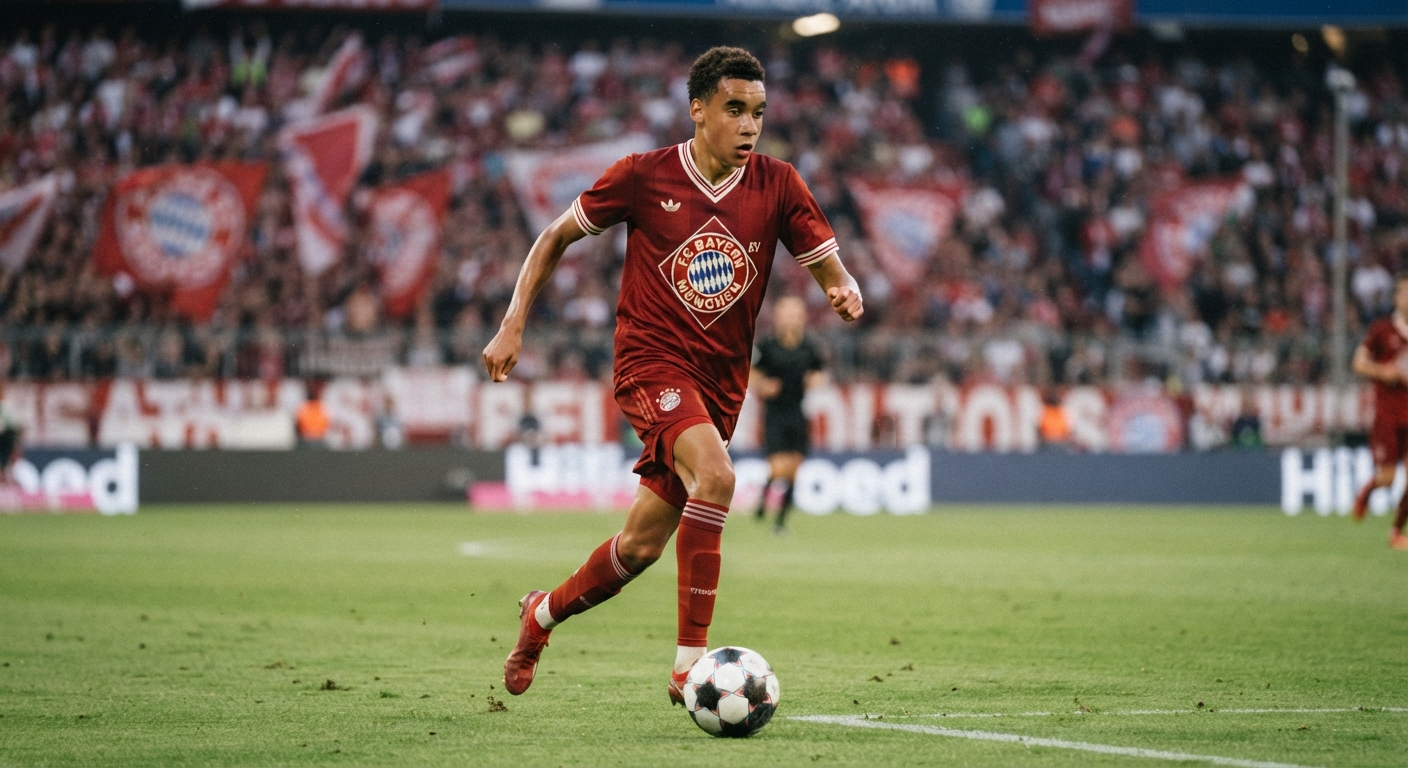
Images of a Bayern Munich retro shirt due out later this year have been circulating on fan forums and sneaker sites for weeks, and they are doing exactly what a good leak is supposed to do: make people argue about a jersey before it has even been confirmed. The shirt leans on a red-and-blue diamond pattern lifted straight from the club crest, with a shimmer running through the fabric that mirrors the illuminated glass panels on the outside of the Allianz Arena. It is a shirt built for two audiences at once — supporters who remember Bayern before the trophies piled up, and a younger fanbase that has only ever known a club that wins.
A Crest Reimagined in Fabric
The diamond motif is the shirt's clearest statement. Bayern's badge has carried that pattern since the club's founding in 1900, but it rarely appears this boldly on a matchday shirt — most modern kits reduce the crest to a small embroidered patch and let sponsor logos and sublimated textures do the talking. This design flips that hierarchy. The diamonds stretch across the torso rather than sitting quietly on the chest, and early images show at least two collar treatments in circulation, suggesting adidas may be testing options before settling on a final version.
A shirt that looks backward while the team is being rebuilt to look forward is a deliberate piece of messaging.
The Allianz Arena reference adds a second layer. The stadium's glass-panel exterior, which turns red, blue or white depending on which club is playing on a given night, has been part of Munich's skyline since it opened in 2005. Stitching that light show into a shirt is the kind of detail that plays well with a fanbase that treats the stadium itself as part of the club's identity, not just the venue where it happens to play.
- Crest origin: diamond pattern dates to Bayern's founding in 1900
- adidas partnership: running continuously since the 1960s
- Last retro release: 2022, which sold out quickly
- Allianz Arena opened: 2005, known for its colour-changing exterior
- Bundesliga titles: more than 30, the most of any German club
adidas and a Partnership Measured in Decades
None of this happens without adidas, whose relationship with Bayern dates back to the 1960s and has outlasted several changes in ownership, management and playing style at the club. Retro releases have become a reliable part of that partnership's rhythm — Bayern's most recent throwback shirt landed in 2022, and it sold well enough that another one was always a matter of when, not if. What makes this version notable is the timing. It arrives as Bayern try to balance two identities: a club that treats domestic dominance as the baseline, and a club still chasing the version of European success that slipped away in recent Champions League campaigns.
Retro kits also carry commercial logic that has nothing to do with sentiment. Limited throwback runs typically sell at a premium and move faster than a club's third or fourth alternate shirt, because collectors buy them alongside supporters who simply want something different from the standard home and away sets. adidas has leaned into that pattern across its wider portfolio, not just at Bayern, and the diamond design fits a broader industry trend of manufacturers digging into archive crests rather than inventing new abstract patterns from scratch.
"You can put a sponsor on anything, but you can't manufacture history — that's why clubs keep going back to the badge." — Markus Weller, football kit historian
Why the Shirt Matters Beyond the Rail
Football kits have long done work that has nothing to do with performance fabric or moisture-wicking claims. They are wearable shorthand for belonging, and a retro release lets a fanbase signal loyalty to a version of the club that predates its current era of financial muscle. For supporters who watched Bayern grind through the 1970s and 1980s before the club became the continental heavyweight it is now, a shirt built around the original crest pattern reads as an acknowledgment that the badge, not the balance sheet, is what actually held the club together.
For newer fans, raised on a Bayern that wins Bundesliga titles as a matter of course, the same shirt functions as an entry point into that history — a way of buying into decades of context without needing to have lived through any of it. That dual appeal is precisely why clubs keep returning to the archive instead of chasing the next abstract graphic: nostalgia sells, but nostalgia dressed as a football shirt sells twice.
Nothing about the release has been confirmed by the club or by adidas, and leaked kit images have a long history of differing in small but meaningful ways from the shirts that eventually reach shelves — collar shapes shift, sponsor placement moves, shades of red get adjusted at the last minute. Even so, the reaction so far tells its own story. A jersey built almost entirely around a century-old crest pattern and a stadium's light display has generated more forum traffic in a few weeks than most confirmed kit launches manage in a season, which suggests Bayern and adidas have found, once again, that the surest way to sell the future is to borrow convincingly from the past.